
The 10 Largest Companies by Market Cap: A Fundamental Investment Assessment
Market-cap ranking and investment attractiveness are completely different things. Here is how I rate the ten largest companies through a fundamental lens — not as a prediction of future returns, but as an assessment of business quality, competitive position, and valuation.

My rating is a fundamental investment assessment, not a prediction of future returns. Market caps are approximate and move daily. The data referenced here runs through September 25–26, 2026.
There is an important distinction that gets lost in most market commentary: market-cap ranking and investment attractiveness are completely different things. A $5.4T company does not automatically represent a better investment than a $1T company. Valuation and future earnings growth matter enormously.
With that framing in mind, here is how I assess the ten largest companies by market capitalization — not as a ranking of which stock will go up, but as a fundamental evaluation of business quality, competitive position, and whether the current price reflects a reasonable expectation of future value.
The Full Rankings at a Glance
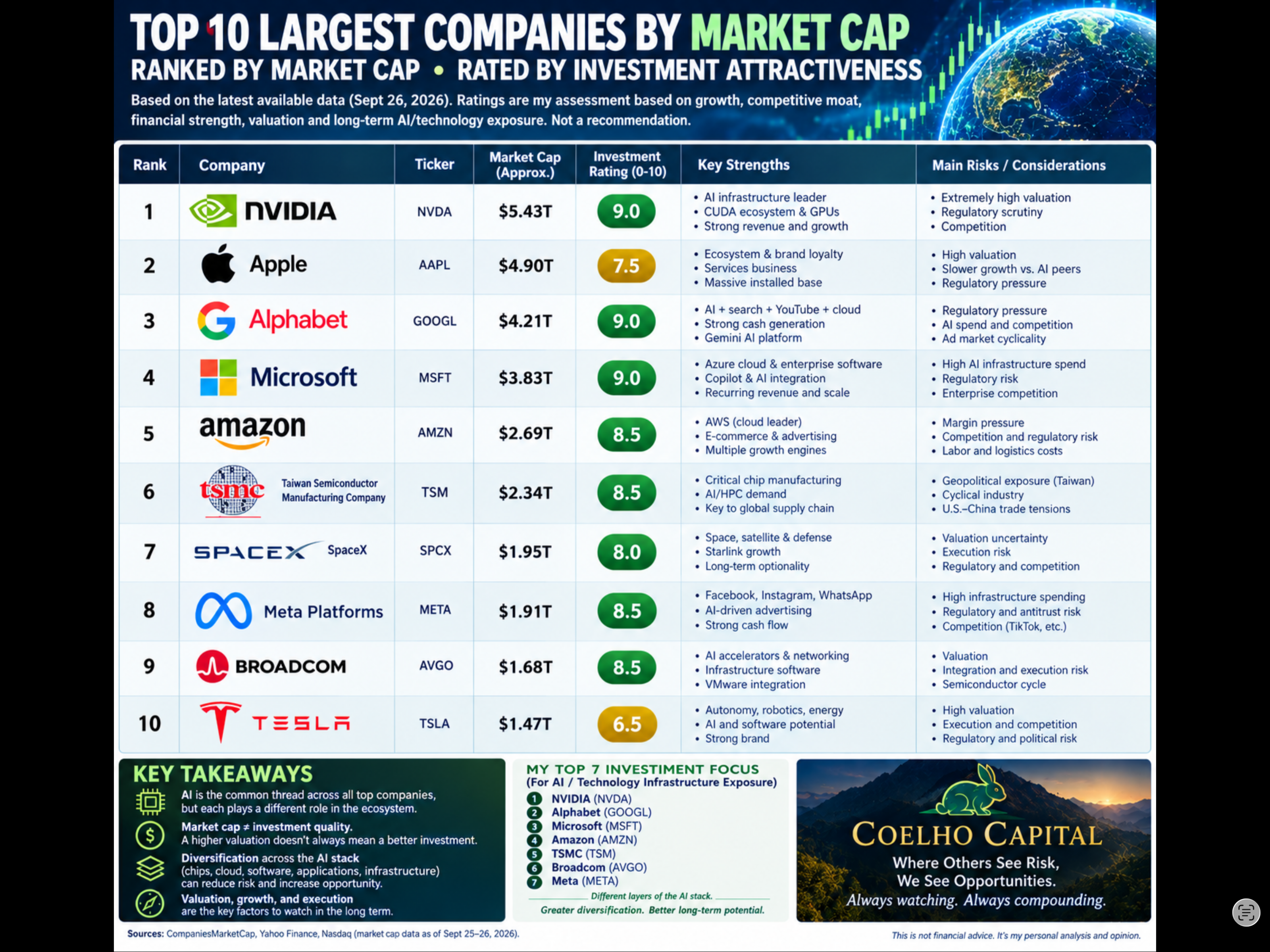
Source: CompaniesMarketCap, Yahoo Finance, Nasdaq. Market cap data as of September 25–26, 2026. Ratings are my assessment based on growth, competitive moat, financial strength, valuation, and long-term AI/technology exposure. Not a recommendation.
NVDA — Rating: 9.0
Nvidia holds an extraordinary position in AI infrastructure. The combination of GPU hardware and the CUDA software ecosystem creates a moat that is genuinely difficult to replicate — competitors are not just building chips, they are trying to rebuild an entire developer platform that has had a decade-plus head start.
Growth has been exceptional. The principal concern is that valuation and expectations are already enormous. This is the classic "great company, but price matters" situation. At current levels, the market is pricing in a sustained dominance that may well materialize — but leaves little room for execution stumbles or competitive inroads.
What I'd watch: Custom silicon from hyperscalers (Google TPUs, Amazon Trainium, Microsoft Maia) and whether AMD can close the software gap.
GOOGL — Rating: 9.0
Google is one of the most interesting combinations in technology: AI research capability, search dominance, YouTube, Google Cloud, and one of the most valuable data assets in the world. Gemini gives it a direct AI platform play, and the advertising business continues to generate enormous cash.
Valuation has historically been less extreme than some AI beneficiaries, which makes the risk/reward more interesting. The regulatory overhang is real but has been a concern for years without fundamentally disrupting the business.
What I'd watch: Whether Gemini can close the gap with OpenAI/Anthropic in enterprise adoption, and the trajectory of Google Cloud market share.
MSFT — Rating: 9.0
Microsoft's position is built on three compounding advantages: Azure's enterprise infrastructure, the Office/Teams/LinkedIn software ecosystem with deep switching costs, and Copilot's potential to increase monetization across an already enormous installed base.
Recurring revenue and enterprise lock-in are major structural advantages. The principal concern is the scale of AI infrastructure investment required — capital expenditure has risen sharply, and the return timeline on that spending is a legitimate question.
What I'd watch: Copilot adoption rates in enterprise, Azure growth trajectory relative to AWS and GCP, and capex discipline.
AMZN — Rating: 8.5
Amazon is effectively two businesses: a massive e-commerce and advertising operation, and AWS — one of the most profitable technology businesses ever built. The combination provides multiple growth engines that are not perfectly correlated.
AI should increase AWS infrastructure demand meaningfully. Margins have substantial room to improve as the logistics network matures and the mix shifts toward higher-margin businesses. The advertising segment is often underappreciated.
What I'd watch: AWS growth rate and margin expansion, advertising revenue trajectory, and whether the retail business continues its margin improvement.
TSM — Rating: 8.5
Taiwan Semiconductor is probably one of the most strategically important companies in the global semiconductor ecosystem. Nvidia, Apple, AMD, and numerous other chip designers depend entirely on TSMC's manufacturing capabilities. There is no near-term substitute.
AI and high-performance computing represent a major structural tailwind. The company's technology lead in advanced nodes (3nm, 2nm) is substantial.
The major unique risk is geopolitical exposure to Taiwan — this is not a standard business risk but a tail risk that is difficult to price and impossible to ignore.
What I'd watch: Geopolitical developments in the Taiwan Strait, progress on TSMC's Arizona and Japan fabs, and whether the technology lead over Samsung and Intel Foundry holds.
META — Rating: 8.5
Meta generates enormous cash from one of the most valuable advertising platforms ever built. Instagram, Facebook, and WhatsApp provide extraordinary distribution — roughly three billion daily active users across the family of apps.
AI is improving advertising targeting and recommendation systems in ways that are already showing up in revenue. The company is also spending heavily on AI infrastructure, which is a cost to watch.
The Reality Labs losses remain a drag, but the core business is strong enough to absorb them while still generating substantial free cash flow.
What I'd watch: AI-driven advertising revenue growth, infrastructure spending discipline, and whether the metaverse investment ever produces a return.
AVGO — Rating: 8.5
Broadcom is an interesting AI infrastructure play beyond Nvidia. The company designs custom AI accelerators for hyperscalers (Google's TPUs, Meta's MTIA) and provides critical networking infrastructure for AI data centers. The software business — significantly expanded by the VMware acquisition — adds a strong recurring revenue component.
The custom silicon opportunity is real and growing. Hyperscalers want alternatives to Nvidia dependency, and Broadcom is one of the few companies with the capability to deliver at scale.
Valuation is the principal thing I would watch. The stock has re-rated significantly on AI enthusiasm.
What I'd watch: Custom ASIC revenue growth, VMware integration progress and margin contribution, and networking infrastructure demand from AI data center buildout.
AAPL — Rating: 7.5
Apple has an extraordinary ecosystem, brand, and customer loyalty that is genuinely difficult to replicate. The services business — App Store, Apple Music, iCloud, Apple Pay — is high-margin and growing. The installed base of over two billion active devices is an enormous distribution advantage.
The lower rating relative to the other 9.0s and 8.5s is primarily a valuation observation. At roughly $4.9T, expectations are already very high. I would distinguish between "great company" and "great stock at today's valuation." Apple Intelligence and AI integration could be meaningful catalysts, but the hardware upgrade cycle has been gradual.
What I'd watch: Services revenue growth, Apple Intelligence adoption and monetization, and whether AI features drive a meaningful iPhone upgrade cycle.
TSLA — Rating: 6.5
Tesla's potential upside from autonomy, robotics (Optimus), energy storage, and AI could be substantial — and I do not dismiss it. Full Self-Driving and the robotaxi opportunity are real possibilities.
The lower rating reflects the fact that the current valuation incorporates significant expectations beyond the traditional auto business. The range of possible outcomes is considerably wider than for the other companies on this list — both to the upside and the downside. That uncertainty, combined with execution risk across multiple simultaneous bets, warrants a more cautious fundamental assessment.
What I'd watch: FSD regulatory approvals and deployment, Optimus production timeline, energy storage growth, and whether the core auto business stabilizes margins.
SpaceX — Not Rated
The market-cap source lists SpaceX at approximately $1.95T. SpaceX is not publicly traded, which makes a formal rating difficult — the information available is limited compared to public companies, and the valuation is set by private market transactions rather than continuous price discovery.
The business is clearly extraordinary: Starlink is a real and growing revenue stream, the Falcon 9 has achieved a cost and reliability advantage that has reshaped the launch market, and Starship represents a potential step-change in space access economics.
How I'd Think About the Group
If I were looking at these specifically through a technology and AI infrastructure lens, the group I would study most closely would be:
NVDA → GOOGL → MSFT → AMZN → TSM → AVGO → META
That is because you are getting exposure to different layers of the AI stack — silicon design, cloud infrastructure, enterprise software, custom accelerators, foundry manufacturing, and advertising/distribution — rather than simply buying the same AI story seven times.
The diversification across the stack matters. A world where Nvidia maintains dominance looks different from a world where custom silicon from hyperscalers takes significant share. Owning multiple layers hedges that uncertainty.
This analysis reflects my fundamental assessment as of late September 2026. It is not investment advice and should not be construed as a recommendation to buy or sell any security. All investments involve risk, including the possible loss of principal.
Explore Topics
Written by
Coelho Capital
Content creator and writer sharing insights and stories.